Insights Websites
Website Design Consultation: What to Expect and How to Prepare
A website design consultation is a first conversation between you and a designer. It is where you decide what the website must do, who it is for, what it will cost and how long it will take. A good one ends with you knowing exactly what you are buying. A poor one ends with a vague quote and a lot of guesswork.
This guide walks through the consultation step by step. It covers what to bring, what gets discussed, the questions worth asking and what you should have in your inbox afterwards. At SR7 Web Design in Seaham, County Durham, the process runs from the first consultation through to launch day, and you deal with the designer who builds your site.
TL;DR
- A consultation should settle one thing: what your website needs to do for your business, such as bring in calls, bookings or online orders.
- Bring your goal, your customers, examples of sites you like, what you already have and a budget you are comfortable with.
- Ask who does the work, what is included, what the fixed price covers, who owns the site and what happens after launch.
- Afterwards you should receive a written scope, a price and a timescale you can compare and sign off.
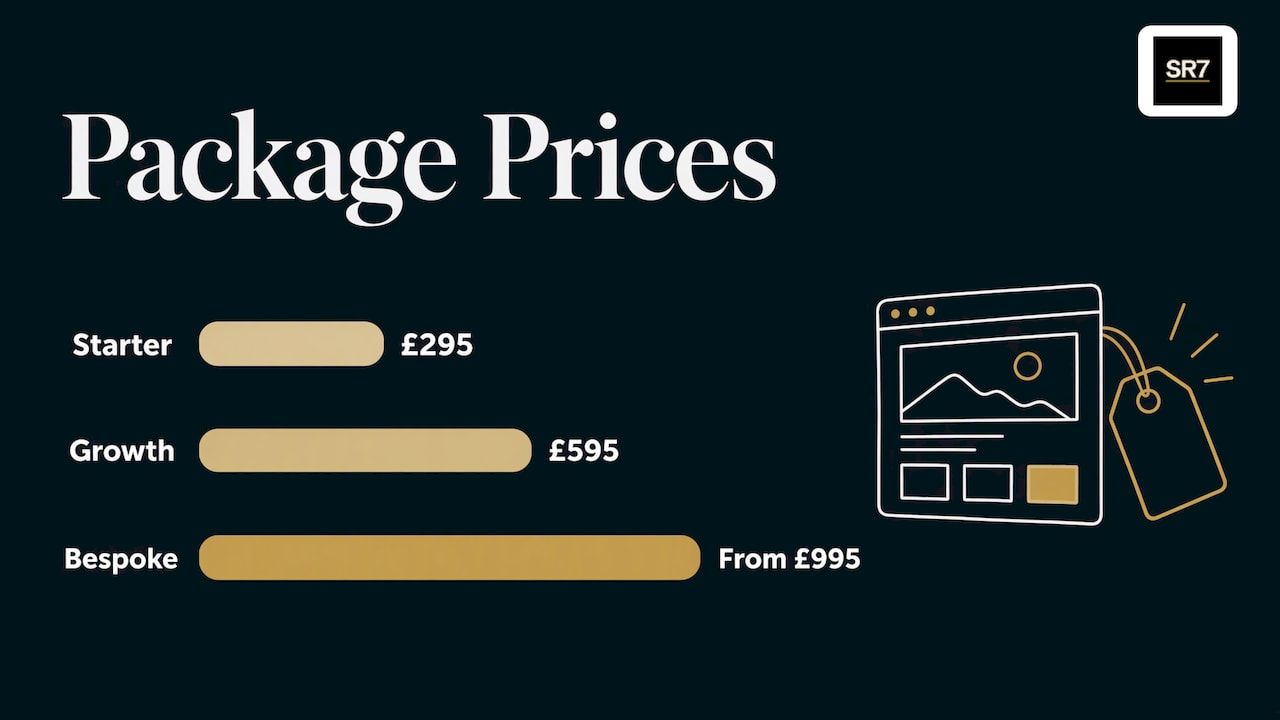
- Our Starter is £295, Growth is £595 and Bespoke starts from £995. You can call us on 0191 722 1678 to book a conversation.
Table of Contents
- What a website design consultation is
- How the consultation process usually runs
- What to prepare before the call
- What should be discussed: the five areas that matter
- Questions to ask the designer
- What to avoid on the call
- What you should have afterwards
- Which package fits what you discussed
- Local or larger studio: what to weigh up
- Talk to SR7 Web Design
- FAQ
- Sources
What a website design consultation is
Think of it as a planning meeting before any design work starts. It can be a phone call, a video call or a coffee. It usually lasts 30 to 60 minutes.
The point is to answer four questions:
- What is the website for?
- Who needs to use it, and what do they want to do?
- What has to be on it to make that happen?
- What will it cost, and when will it be ready?
If you leave without clear answers to those, the consultation has not done its job. You are not there to be sold to. You are there to decide, with a designer’s help, what a sensible website looks like for your business.
Some people call this a discovery call or a discovery session. Larger agencies sometimes spread it over several meetings with interviews and research. For a small business, one good conversation plus a written follow-up is normally enough.
How the consultation process usually runs
The order varies, but most go through the same stages.
1. Your goal
The designer asks what you want the site to achieve. “A new website” is not a goal. “More enquiries from homeowners in Sunderland” is. “Let customers book a class without phoning” is. “Sell our products to people outside the North East” is.
One clear goal shapes every later choice: the layout, the wording, the buttons and the features.
2. Your customers
Next comes who you are talking to. Where do they find you now? Are they on a phone or a laptop? Are they in a hurry, like someone with a burst pipe, or comparing options over a week, like someone choosing a wedding photographer?
The answers decide what goes at the top of the page. A tradesperson’s visitors need a phone number they can tap. A shop’s visitors need to see products and prices fast.
3. Your content
The designer asks what you have: logo, photos, service descriptions, prices, reviews, opening hours. Then what is missing. Wording and photos are the most common cause of delay on any web project, because they are the one thing only you can supply.
SR7 covers design, copywriting and build for each project, so you are not left to write every page yourself. We explain more about what we ask for up front in the five things we ask for before we build your site.
4. Features
Now you list what the site has to do. Typical features for small businesses include:
- An enquiry form or a click-to-call button
- Online booking, payments or a members area
- An online shop with a basket and checkout
- A map and your Google Business Profile details (the listing that shows when people search for you on Google)
- A page for each service or each area you cover
Not everything has to be built on day one. A good designer helps you separate what you need at launch from what can wait.
5. Budget and timescale
This is where you talk money. Say what you are comfortable spending. It lets the designer suggest what fits rather than quoting something you cannot afford. Then agree when you need the site live and what could slow it down, such as waiting for photos.
6. Next steps
The call should end with an agreed next step: a written proposal, a date for it to arrive and what you need to send in the meantime.
What to prepare before the call
You do not need a brief or any technical knowledge. A page of notes is plenty. Here is what makes the conversation useful.
Write down one main goal
Pick the one thing the site must do. You can add secondary goals, but if everything is a priority, nothing is. Most small business sites have one of three jobs: bring in phone calls and enquiries, take bookings, or sell products.
Describe your best customer
Write two or three lines on the person you most want to hear from. What do they ask you? What worries them before they buy? Where are they based? Local customers in Durham or Hartlepool need different content from customers across the UK.
Gather examples you like and dislike
Pick three or four websites, from any industry, and note what you like about each. It might be the clear layout, the big photos or how easy it is to find the price. Note one or two you dislike as well. This tells a designer your taste faster than any description.
Review what you already have
If you have a website, note what works and what does not. How many enquiries does it bring in each month? Do you know which pages people visit? Can you edit it yourself, or do you have to ask someone? If you have no site, list where customers currently find you: Facebook, word of mouth, a directory.
If you want a second opinion on an existing site before the call, we offer a free website review.
Gather your materials
Have these to hand, even if they are rough:
- Your logo and brand colours, if you have them
- A list of your services or products, with prices where you show them
- Photos of your work, premises or team
- Customer reviews you already have, with permission to use them
- Your domain name (your web address) and who currently hosts the site, if you have one
Decide on a budget range
You do not need an exact figure. A range works. Knowing it lets the designer tell you straight away what is realistic. Our own fixed prices are published, so there are no surprises: Starter is £295, Growth is £595 and Bespoke starts from £995.
What should be discussed: the five areas that matter
A useful consultation covers these areas. If one is missing, ask about it.
| Area | What to settle | Why it matters |
|---|---|---|
| Goal | The one action you want visitors to take | Shapes the design and the wording |
| Audience | Who visits and on what device | Decides layout and what sits at the top |
| Content | What exists, what must be written or photographed | Biggest cause of delays |
| Features | Forms, bookings, shop, payments | Affects scope and price |
| Aftercare | Who updates, secures and fixes the site | Keeps the site working after launch |
Accessibility
Ask how the site will work for people with disabilities, for example people who use screen readers or who find small text hard to read. All UK service providers have a legal duty to make reasonable adjustments under the Equality Act 2010, and a website is part of how you serve customers. Accessibility is part of how we build, not an extra.
Cookies and privacy
If your site uses cookies or similar tools to track visitors, UK rules say you must tell people about them, explain what they do and get consent, apart from cookies that are essential to the service, such as remembering a shopping basket. Ask who sets this up. If you are unsure about your own legal position, speak to a solicitor.
Speed and mobile
Most of your visitors will arrive on a phone. Ask how the site will be built to load quickly and look right on a small screen. Performance is part of our build process.
Search
If you want local customers to find you, say so in the call. Page titles, service pages and your Google Business Profile all affect that. We cover it on our local SEO page.
Questions to ask the designer
A consultation runs both ways. These questions tell you how the project will go.
About who does the work
- Who will design and build my site? Will I speak to that person directly?
- Is any of the work passed to someone else?
- Is the design made for my business or adapted from a ready-made template?
At SR7 the sites are hand-built, and you have direct access to the designer from start to finish. It is a fair thing to ask any provider, and the answer tells you a lot.
About what you get
- What exactly does the price include: design, writing, photos, forms, booking, shop?
- How many pages are covered?
- What is not included, and what would it cost to add later?
- Is the price fixed, or can it change as we go?
About ownership and control
- Will I own the website and the domain name?
- Can I edit the text and images myself?
- If I want to move to someone else later, can I?
About time
- How long from sign-off to launch?
- What do you need from me, and by when?
- What usually causes delays?
About after launch
- Who looks after updates, security and backups?
- What does ongoing care cost, and is it optional?
- What happens if something breaks?
Our ongoing care is optional: Website Care is £25 a month and Managed Website Care is £50 a month. If you want to know what upkeep typically costs across the UK, read what website maintenance really costs a small UK business.
About results
- How will we know the site is working?
- What will you set up so I can see calls, enquiries or orders?
What to avoid on the call
- Do not say “just make it look nice”. Looks matter, but the site has to do a job.
- Do not copy a competitor’s site. Use it as a reference for what works, not as a template for yours.
- Do not hold back your budget. Without it, you will get quotes that are far too big or far too thin.
- Do not agree to a price without a written scope. If the price is spoken only, you cannot check later what was promised.
- Do not leave the content for later. Decide who writes the text and who takes the photos before you sign.
What you should have afterwards
Within a few days of the call you should receive something in writing. At the very least it should include:
- A summary of your goals and audience. This shows the designer listened.
- A scope. The pages, features and services that are included.
- A price. The total, what it covers and when payment is due.
- A timescale. Key stages and what you need to supply at each.
- Ongoing costs. Hosting, care and support, if any.
Read it against your notes from the call. If a feature you discussed is missing, ask. If the scope is vague, ask for it to be made specific. If you are comparing two proposals, check that each includes the same things, because a cheaper quote often leaves out copywriting, booking or accessibility work.
Which package fits what you discussed
Once you know your goal and features, the package choice is usually simple. Our published prices are one-off, fixed amounts.
| Package | Price | Usually suits |
|---|---|---|
| Starter | £295 | A business that needs a clear, professional online presence to get started |
| Growth | £595 | A business that wants more pages and a stronger route to enquiries |
| Bespoke | From £995 | A business that wants a fully custom design and build |
An online shop starts from £995 and has its own page, ecommerce web design. If you already have a site that is not working, our website redesign page and redesign checklist show what the process involves before, during and after launch.
You can see the full list on our services and pricing page.
Local or larger studio: what to weigh up
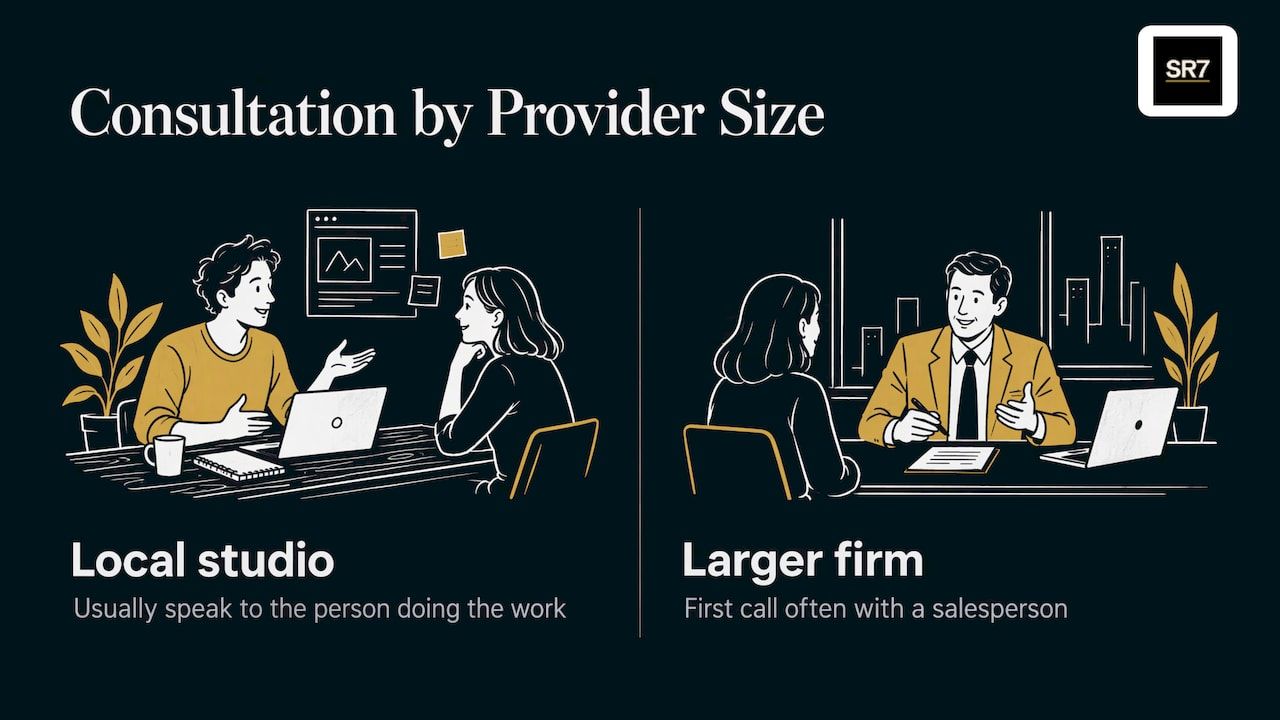
When you choose who to talk to, the size of the provider shapes the consultation. With a small local studio you usually speak to the person doing the work. With a larger firm the first call is often with a salesperson. We set out the differences in local web designer versus big agency for North East businesses.
We work with businesses in Seaham, Sunderland, Durham, Newcastle, Hartlepool and Teesside, and across the UK. If you are in Sunderland, see web design in Sunderland.
Talk to SR7 Web Design
We build hand-made, fully customised websites for small businesses. Design, copywriting and build are tailored to your business, and you deal directly with the designer from the first consultation to launch day. Prices are fixed and published, from £295.
If you are ready to talk it through, call 0191 722 1678 or email info@sr7webdesign.co.uk. Tell us your goal and we will tell you what fits.
See bespoke web design for small businesses for how we work.
FAQ
How long does a website design consultation take?
Usually between 30 and 60 minutes. That is enough to cover your goal, audience, content, features, budget and timescale. Preparing notes beforehand keeps it short and useful.
Do I have to pay for a consultation?
Policies differ between providers, so ask when you book. At SR7 you can call 0191 722 1678 or email info@sr7webdesign.co.uk to talk through your project, and our free website review looks at an existing site.
What should I bring to a web design consultation?
Bring your main goal, a description of your best customer, a few websites you like, your logo and photos if you have them, and a budget range. If you have a current site, bring its address and note what you want to change.
What happens after the consultation?
You should receive a written proposal with the scope, price and timescale. Check that it matches what you discussed. Once you agree, you supply your content and the design and build begin.
Do I need to know anything technical?
No. A good designer explains each term in plain English and asks questions about your business rather than about technology. Your job is to know your customers and what you want the site to achieve.
Sources
- GOV.UK: Understanding accessibility requirements for public sector bodies
- ICO: Cookies and similar technologies
Recommended
- Website redesign checklist: before, during and after launch
- Web design services for small businesses: what you should get, and what it should cost
- Website Redesign in the North East Without Losing Your Rankings
- The 5 Things We’ll Ask You For Before We Build Your Site (And Why Most Agencies Forget Them)