Insights Websites
Web Design Middlesbrough: A Plain Guide for Small Businesses
If you run a business in Middlesbrough and need a website that brings in enquiries, bookings or sales, the choice that matters most is who builds it and how much of the work they do themselves. At SR7 Web Design, one designer plans, writes and builds your site by hand. You deal with that person from the first conversation to launch day, and you know the price before work starts. We are based in Seaham, County Durham, and we build sites for small businesses across Teesside and the rest of the UK.
This guide explains what a web designer actually does, how a project runs, what to look for in a quote and a contract, and which features earn their place on a small business site.
TL;DR
- A good web design project covers design, writing, build, mobile speed, accessibility and launch, not just a pretty homepage.
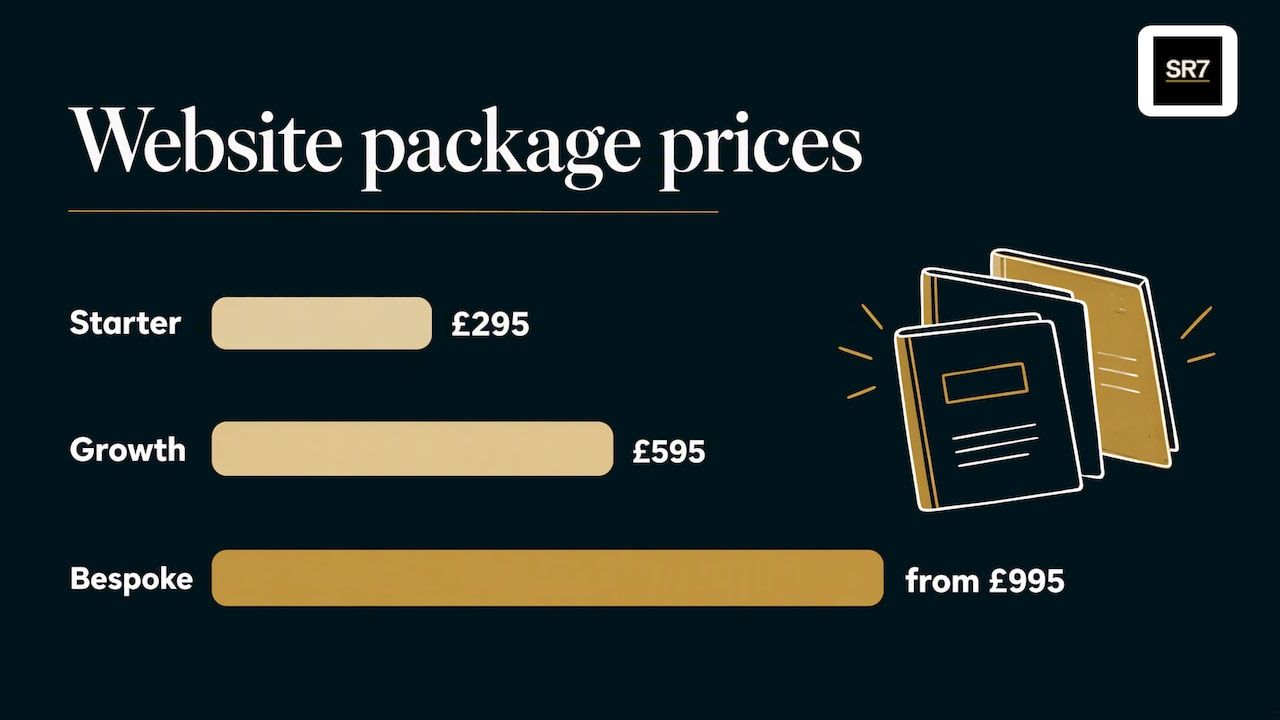
- Ask for a fixed price in writing. Our prices are Starter £295, Growth £595 and Bespoke from £995, with Website Care at £25 a month or Managed Website Care at £50 a month.
- Check who owns the finished site in the contract, because paying for a website does not automatically mean you own every part of it.
- A site that wins work makes it easy to ring, book or buy in two taps, and it says clearly what you do and where.
- Direct access to the person building your site saves weeks of messages passed between account managers and outsourced developers.
Table of Contents
- What a web designer in Middlesbrough should actually do for you
- Template site or bespoke site: what you are really paying for
- How a web design project works, step by step
- What affects the price and the timescale
- Who owns your website once it is built?
- Features that bring in enquiries, bookings and sales
- Thinking of an online shop?
- Accessibility, speed, security and support: what to ask
- Redesigning an existing site
- Local search: being found in Middlesbrough
- Why work with SR7 Web Design
- FAQ
- Sources
What a web designer in Middlesbrough should actually do for you
Most small business owners do not want to learn how websites work. You want a site that looks like your business, loads quickly on a phone and gets customers to contact you. A designer’s job is to get you there without you needing to learn any of the technical side.
A proper project usually covers these parts:
- Design. The look of every page, based on your brand, your customers and what you sell. Not a ready-made layout with your logo dropped in.
- Copywriting. The words on the page. Many sites fail here because the owner is left to write everything alone. Clear, specific wording tells visitors what you do, where you work and how to reach you.
- Build. Turning the design into a working site that behaves on phones, tablets and desktops.
- Speed and accessibility. A site that loads fast and can be used by people with visual, hearing or motor difficulties, including people who navigate by keyboard or screen reader.
- Enquiry and booking tools. Contact forms, booking systems, payment options and, for shops, a basket and checkout.
- Local search basics. Page titles, your address and service areas set up properly, and a link to your Google Business Profile (the free listing that shows your business on Google Maps and in local results).
- Launch and support. Getting the site live without losing anything, and having someone to call afterwards.
When you compare quotes, check that each one lists these parts. A low price that leaves out the writing, the mobile checks or the launch just moves the work onto you.
Template site or bespoke site: what you are really paying for
A template site starts from a layout that thousands of other businesses already use. It is quick to set up, and that is its appeal. The trade-off is that you adapt your business to the layout, and visitors often cannot tell you apart from the next company.
A bespoke site starts from your business. We design the pages around what your customers need to find, write the copy to match, and build it by hand. You have full control over the design and the build process, and you are not handed to an outsourced team halfway through.
This matters most when you:
- sell something customers compare carefully, such as trades work, treatments, memberships or food;
- need a particular booking flow, for example a class timetable or a quote request that asks the right questions;
- want your site to look as good as your premises, vans or products.
If you are starting small, our Starter package at £295 is a one-off fee for a professional, hand-built site. Growth at £595 and Bespoke from £995 give you more room as your business needs it. You can see what each includes on our services page.
How a web design project works, step by step
Here is the routine from first call to launch, and where it can go wrong if you do it with the wrong designer.
1. The first conversation
You explain what you sell, who buys it and what you want the site to do: more phone calls, more bookings, more online orders. A good designer asks questions. If the first conversation is only about colours and fonts, the project will be about colours and fonts.
Where it goes wrong: you are handed a form to fill in and never speak to the person who will build the site. At SR7 you have direct access to the designer from the start.
2. Scope and fixed price
You agree which pages are needed, what features are included and what it costs. Ask for the price in writing and ask what is not included. Typical extras that catch people out are copywriting, photography, booking systems, hosting and monthly upkeep.
Where it goes wrong: a low headline price, then separate charges for each extra. Our published prices are fixed, and we tell you before work starts what your project involves.
3. Design and wording
The designer shows you how the main pages will look and what they will say. This is the time to give honest feedback. Keep it practical: does the homepage tell a stranger what you do within a few seconds? Is your phone number easy to find on a mobile?
Where it goes wrong: placeholder text that never gets replaced. Because copywriting is part of every SR7 project, the words are written for your business rather than left for you to fill in.
4. Build and testing
The pages are built, forms and booking tools are connected and everything is tested on real phones and browsers. Test your own forms. Send yourself an enquiry and check it arrives in the inbox you actually read.
Where it goes wrong: a site that looks fine on the designer’s big screen but is slow or awkward on a phone. Performance and accessibility are part of how we build, not an add-on.
5. Launch
The site goes live on your domain. If you are replacing an old site, the old page addresses should be redirected so you do not lose the search visibility you have already earned. This is the step most often rushed, so ask how it will be handled.
6. After launch
Websites need looking after: updates, backups, security checks and the occasional content change. Decide before launch who will do this. We offer Website Care at £25 a month and Managed Website Care at £50 a month, and you can read about what website maintenance really costs a small UK business before you decide.
What affects the price and the timescale
The things that move the cost of a website are fairly simple:
- How many pages you need. A five-page service site is a different job from a catalogue of products.
- Whether you need a shop, bookings or payments. These add build and testing time.
- Who writes the words and supplies the images. If the designer does it, it is part of the work. If you do it, it often becomes the reason a project runs late.
- Hosting and upkeep. These continue after the build. Ask what they cost each month and what they cover.
- How quickly you give feedback. Most delays come from waiting for text, photos and approvals.
The best way to compare quotes is to ask each one the same questions: what is included, what is extra, what do I pay each month and who do I call when something breaks?
Our fixed prices are Starter £295, Growth £595 and Bespoke from £995, all one-off. Ecommerce web design is available on our ecommerce page and starts from £995 too. Website Care is £25 a month and Managed Website Care is £50 a month.
Who owns your website once it is built?
This is the question most owners forget to ask until it is a problem. In the UK, the person who creates an original piece of work usually owns the copyright unless the contract says otherwise. Sprintlaw’s guide to UK web design contracts explains that paying for a website does not automatically hand you the source code, graphics or templates, and that a contract should separate work made specially for you from a designer’s existing tools and code libraries.
In plain terms, before you sign anything, check three things:
- What you own. Your text, images, logo and the finished design should be yours.
- What the designer keeps. Reusable tools are normally kept by the designer. That is reasonable, but the contract should say so, and it should say you can keep using them on your site.
- Your domain and hosting. The domain name should be registered in your name, and you should have the log-in details.
If you are not sure how to read a contract, a solicitor can check it for you. Our own aim is to keep things straightforward, with the scope and price agreed up front.
Features that bring in enquiries, bookings and sales
A website for a small business has one job: to turn a visit into a contact. These are the features that do the most.
Make it easy to call
Most local searches happen on phones. Put a tap-to-call button at the top of every page, so someone standing in their kitchen with a burst pipe or a broken oven can ring you in one tap. Our number is 0191 722 1678, and a site you commission should make yours just as easy to use.
Say where you work
If you cover Middlesbrough, Stockton, Redcar or Hartlepool, say so on the page, in plain words. Visitors and search engines both need to know your area. A page that clearly lists the places you serve is far more useful than a vague line about “the local area”.
Use short, clear enquiry forms
Every extra field in a form costs you enquiries. Ask for a name, a phone number or email address and what the person needs. If you need more detail, you can ask on the phone.
Show proof that is real
Photos of your own work, your real address and genuine customer comments build trust. Use only what is true and that you have permission to show. You can look at how we present real projects on our Digital Beacon and East Coast Seafoods pages.
Add booking and payment where it helps
If customers book appointments, classes or tables, an online booking tool saves you phone calls and missed messages. If you take deposits or sell memberships, payments belong on the site too. We build booking, payments and members features as part of our services.
Keep it fast
Slow pages lose visitors, especially on mobile data. Compressing images, keeping pages light and avoiding unnecessary add-ons all help. It is one of the areas where a hand-built site has a clear edge over one loaded with extra plug-ins.
Thinking of an online shop?
If you sell products, a customised ecommerce site lets the shop follow your brand rather than the platform’s default layout. Here is what to consider before you commission one:
- Product pages. Each needs clear photos, honest descriptions, sizes or options, and delivery information.
- Checkout. Fewer steps means fewer abandoned baskets. Guests should be able to buy without creating an account.
- Delivery and returns. State your costs and policies where customers can see them before they pay.
- Accessibility. An online shop must be usable by everyone, including people using screen readers or a keyboard. Our ecommerce website accessibility guide goes through what to check.
- Moving from an old shop. If you already trade online, plan the move so you keep your search visibility. Our guide to ecommerce website redesign covers this.
Accessibility, speed, security and support: what to ask
These four things are easy to overlook when comparing quotes, and they are the ones that cause trouble later.
- Accessibility. Ask whether the site will work with a keyboard and a screen reader, whether text has enough contrast and whether images have descriptions. It is good practice and it widens your audience. Our article on whether your website passes the 2026 accessibility test is a good starting point.
- Mobile speed. Open the designer’s own work on your phone, on mobile data rather than Wi-Fi. If it feels slow to you, it will feel slow to your customers.
- Security. Ask who keeps the site updated and backed up. Out-of-date software is a common way sites get hacked.
- Support. Ask what happens when something breaks at 4pm on a Friday. Our Website Care plans cover ongoing upkeep at £25 or £50 a month, and ad-hoc support is £50 per hour.
Redesigning an existing site
Many Middlesbrough businesses already have a site that is old, slow or hard to update. A redesign does not have to mean starting from nothing. The pages that bring you visitors should keep their addresses or be redirected properly, and the content that works should be kept and improved. Our website redesign service is built around that approach. If you are unsure whether your current site is the problem, our free website review is a simple place to start.
Local search: being found in Middlesbrough
A good-looking site is no use if nobody finds it. For a business serving a town, local search matters most. The basics are:
- A complete Google Business Profile with the right address, hours, services and photos.
- A page on your site for each main service, with the town names you cover.
- Consistent business details, so your name, address and phone number match everywhere they appear.
- A fast, mobile-friendly site.
We set up the site side of this, and our local SEO service goes further. For more detail, see our guide to local SEO in North East England.
Why work with SR7 Web Design
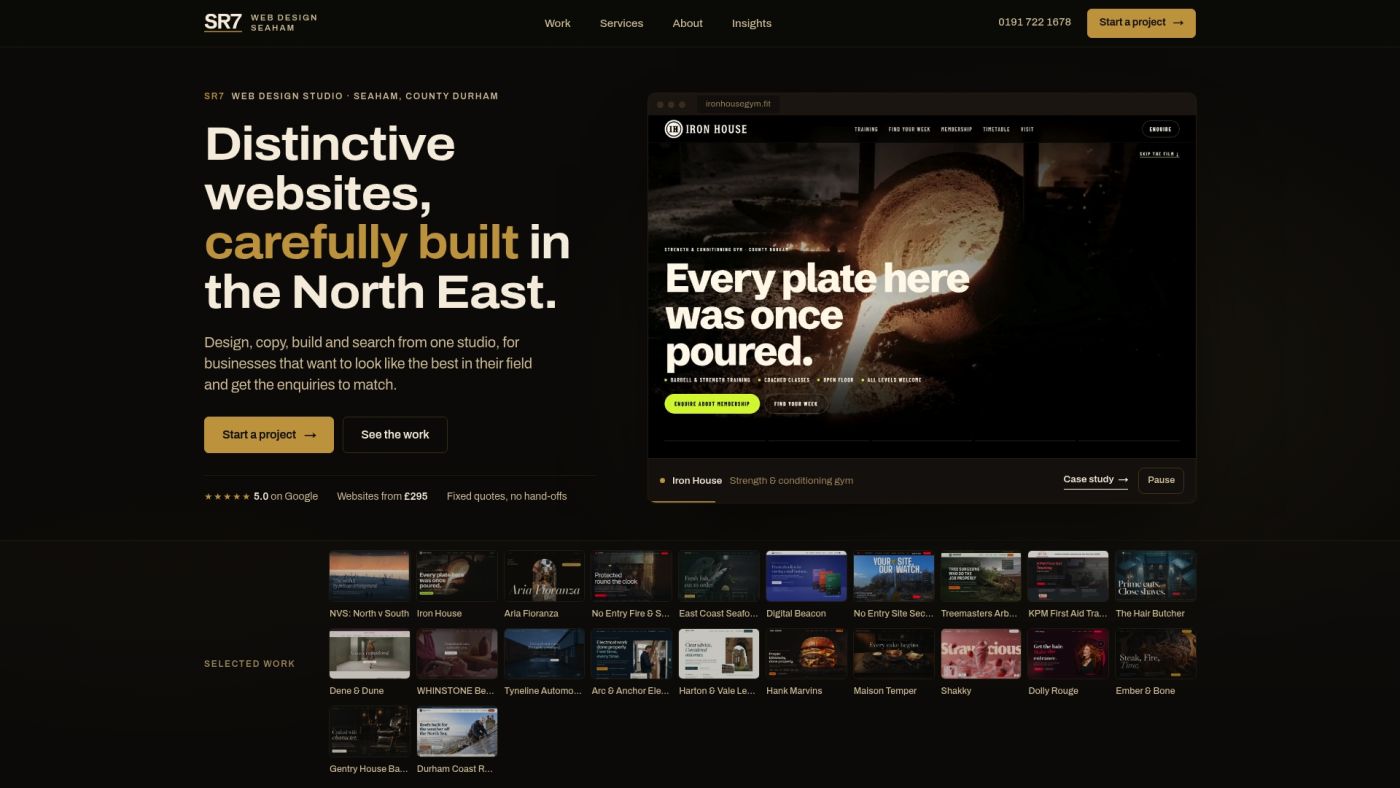
SR7 is a small studio in Seaham, County Durham. Every project is designed, written and built for the business, with no generic templates and no outsourced work, and you talk directly to the designer from start to finish. We work with small businesses in restaurants, gyms, retail, trades and professional services, and we serve Teesside as well as Sunderland, Durham, Newcastle and Hartlepool.
Starter is £295, Growth is £595 and Bespoke starts from £995. Website Care is £25 a month and Managed Website Care is £50 a month. See the full range on our bespoke web design page.
To talk through your project, ring 0191 722 1678 or email info@sr7webdesign.co.uk. We will tell you what you need and what it costs.
FAQ
How much does a website cost for a small business?
Our Starter site is £295, Growth is £595 and Bespoke starts from £995, all as one-off fees. Ecommerce web design also starts from £995. Monthly care is £25 or £50 if you want us to look after the site after launch.
Do I need a web designer based in Middlesbrough?
Not necessarily. What matters is that the designer understands your customers and your area, and that you can speak to them directly. We are in Seaham, a short way up the coast, and we work with businesses across Teesside by phone, email and video call.
What should I have ready before I contact a designer?
A short note on what you sell, who your customers are and what you want the site to do. Add your logo and any photos you already have, and examples of sites you like. You do not need to have the wording ready, as copywriting is part of our work.
Will I own my website?
You should, and you should check it in writing. In the UK, the creator of original work usually owns the copyright unless the contract says otherwise, so ask for ownership of your content, design and domain to be spelled out before you sign.
What happens after the site goes live?
Sites need updates, backups and the odd change. Website Care at £25 a month and Managed Website Care at £50 a month cover this, and ad-hoc support is available at £50 per hour if you only need occasional help.
Sources
Recommended
- The Small Business Owner’s Guide to Affordable Web Design in County Durham
- Affordable Web Design in Sunderland & Durham: Why Local Businesses are Ditching the Big Agencies
- The Small Business Owner’s Guide to Local SEO in North East England
- Your Quick-Start Guide to Web Design for Startups: How to Launch in the North East Without Breaking the Bank